
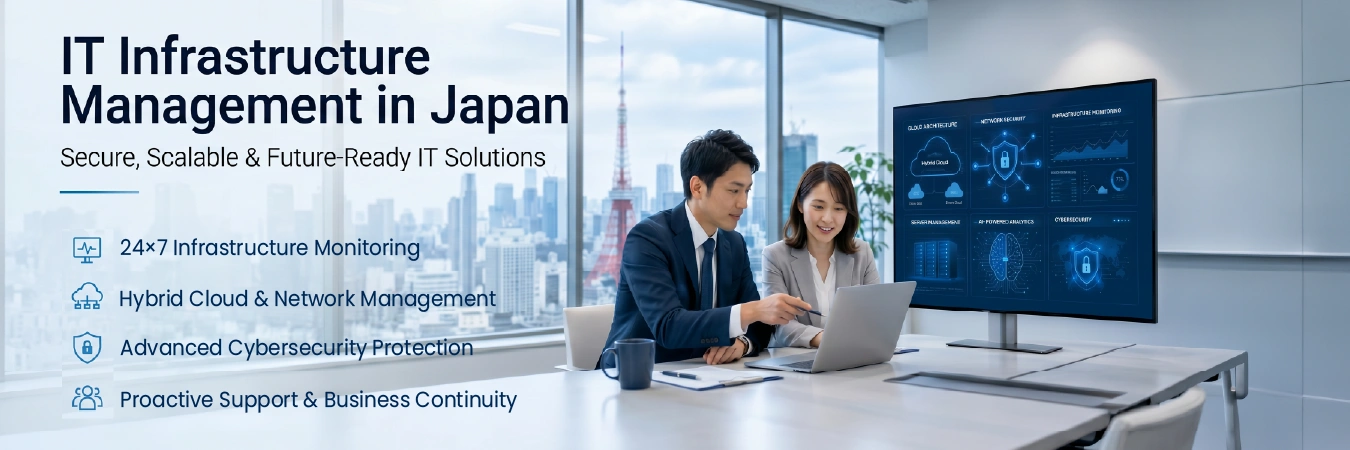
IT Infrastructure Management Japan: Key Challenges and Solutions
As Japanese businesses continue to embrace digital transformation, the demand for reliable, secure, and scalable IT infrastructure management Japan has grown significantly. Organizations across manufacturing, automotive, finance, healthcare, logistics, and retail rely on stable IT environments to support daily operations, cloud adoption, cybersecurity, and business continuity. However, managing modern IT infrastructure in Japan presents unique challenges, including aging legacy systems, increasing cybersecurity risks, compliance requirements, and a shortage of skilled IT professionals.
To overcome these challenges, businesses are increasingly partnering with experienced technology providers that offer comprehensive infrastructure management, proactive monitoring, and round-the-clock support. With the right strategy and expertise, companies can improve operational efficiency, reduce downtime, strengthen security, and create a future-ready IT environment.
This blog explores the key challenges organizations face in Japan and the solutions that help businesses build resilient IT infrastructure.
Understanding Modern IT Infrastructure
IT infrastructure is the foundation that supports an organization’s digital operations. It includes servers, storage systems, networking equipment, cloud platforms, databases, operating systems, virtualization technologies, security solutions, and end-user devices.
Effective infrastructure management ensures that these components work seamlessly together while maintaining:
- High availability
- Strong security
- Optimal performance
- Business continuity
- Regulatory compliance
- Scalability for future growth
As organizations adopt hybrid and multi-cloud environments, infrastructure management has become increasingly complex, requiring continuous monitoring, automation, and specialized expertise.
Why Businesses Need IT Infrastructure Management Services?
Modern enterprises cannot afford system outages or security vulnerabilities. Investing in professional IT infrastructure management services enables organizations to maintain stable operations while allowing internal teams to focus on strategic initiatives.
Some major benefits include:
1. Improved System Availability
Continuous monitoring identifies issues before they impact business operations, minimizing downtime and improving reliability.
2. Better Security
Infrastructure management includes security monitoring, patch management, firewall administration, endpoint protection, and vulnerability assessments.
3. Cost Optimization
Businesses can reduce unnecessary infrastructure costs by optimizing server utilization, cloud resources, storage, and network performance.
4. Enhanced Performance
Regular maintenance and performance tuning ensure applications, databases, and networks operate efficiently.
5. Simplified Compliance
Organizations operating in Japan must comply with industry standards and internal governance policies. Professional infrastructure management helps maintain compliance through documentation, monitoring, and security best practices.
Major Challenges in IT Infrastructure Management Japan
Organizations across Japan face several infrastructure management challenges that require strategic planning and specialized expertise.
1. Managing Legacy Systems
Many Japanese enterprises continue to operate mission-critical legacy applications developed over decades. While these systems remain essential, integrating them with modern cloud platforms and digital technologies is often difficult.
Common issues include:
- Limited compatibility with new technologies
- High maintenance costs
- Lack of vendor support
- Security vulnerabilities
- Complex modernization requirements
A structured modernization roadmap allows organizations to gradually upgrade infrastructure without disrupting business operations.
2. Cybersecurity Threats
Cyberattacks continue to increase worldwide, affecting organizations of every size. Infrastructure must be continuously protected against threats such as ransomware, phishing attacks, malware, unauthorized access, and data breaches.
Businesses need:
- Continuous security monitoring
- Endpoint protection
- Network security
- Identity and access management
- Multi-factor authentication
- Security patch management
- Incident response planning
Infrastructure management plays a critical role in maintaining a strong security posture.
3. Hybrid Cloud Complexity
Many organizations in Japan now operate hybrid IT environments combining:
- On-premises servers
- Private cloud
- Public cloud
- SaaS applications
- Edge computing
Managing these environments requires expertise across multiple platforms while maintaining consistent performance, security, and governance.
Without centralized infrastructure management, organizations often experience:
- Configuration inconsistencies
- Resource inefficiencies
- Higher operational costs
- Increased security risks
4. Growing Compliance Requirements
Japanese businesses must comply with industry regulations, internal governance frameworks, and customer security expectations.
Infrastructure management teams help organizations maintain compliance through:
- Secure access controls
- Audit logging
- Data protection policies
- Backup management
- Disaster recovery planning
- Infrastructure documentation
Proper governance reduces business risk while improving customer trust.
5. IT Skills Shortage
Like many developed economies, Japan faces a growing shortage of experienced IT professionals. Recruiting infrastructure specialists for networking, cloud computing, cybersecurity, and systems administration has become increasingly difficult.
As a result, organizations are turning to managed service providers that offer experienced technical teams capable of supporting complex infrastructure environments.
Remote IT Infrastructure Management Services for Modern Businesses
The rise of cloud computing has made remote IT infra management services an essential component of modern enterprise operations.
Rather than relying solely on onsite support, businesses now benefit from remote monitoring, proactive maintenance, automated alerts, and rapid issue resolution.
Remote infrastructure management typically includes:
- 24×7 infrastructure monitoring
- Server administration
- Network management
- Cloud infrastructure support
- Backup monitoring
- Patch deployment
- Performance optimization
- Security monitoring
- Helpdesk support
- Incident management
Remote services reduce response times while lowering operational costs and improving service availability.
Choosing the Right IT Infrastructure Management Service Provider
Selecting the right IT infrastructure management service provider is essential for organizations looking to improve system reliability, enhance security, and support long-term business growth. An experienced provider offers proactive monitoring, expert technical support, and scalable infrastructure solutions tailored to business requirements.
Businesses should evaluate providers based on several factors.
- Industry Experience: Experience supporting industries such as manufacturing, automotive, BFSI, healthcare, logistics, and retail enables providers to understand industry-specific requirements.
- Proactive Monitoring: Rather than reacting to failures, providers should continuously monitor systems and resolve issues before they affect users.
- Scalability: Infrastructure services should support business growth without requiring significant redesign or operational disruption.
- Security Focus: The provider should implement robust security controls, vulnerability management, access governance, and regular updates.
- Service Level Agreements (SLAs): Clearly defined SLAs ensure predictable response times, issue resolution targets, and service quality expectations.
Emerging Trends Shaping Infrastructure Management Japan
Infrastructure management continues to evolve alongside digital transformation initiatives.
Key trends include:
1. AI-Driven Infrastructure Monitoring
Artificial intelligence helps detect anomalies, predict failures, automate remediation, and improve infrastructure reliability.
2. Infrastructure as Code (IaC)
Infrastructure provisioning through code enables faster deployment, improved consistency, and reduced configuration errors.
3. Edge Computing
Manufacturing and industrial organizations increasingly deploy edge infrastructure to support real-time analytics and connected devices.
4. Zero Trust Security
Organizations are implementing Zero Trust architectures that continuously verify users, devices, and applications before granting access.
5. Sustainable IT Operations
Energy-efficient infrastructure, optimized resource utilization, and cloud modernization initiatives help organizations achieve sustainability goals while reducing operational costs.
Why Japanese Businesses Benefit from Managed Infrastructure Services?
Managed infrastructure services offer organizations several long-term advantages.
These include:
- Reduced operational costs
- Improved business continuity
- Faster incident resolution
- Stronger cybersecurity
- Better compliance management
- Increased infrastructure visibility
- Predictable IT spending
- Higher employee productivity
- Greater scalability
- Access to specialized technical expertise
By outsourcing infrastructure management, organizations can focus on innovation, customer experience, and business growth instead of day-to-day infrastructure maintenance.
How Fidel Supports IT Infrastructure Management in Japan?
At Fidel, we help organizations build secure, resilient, and high-performing IT environments through comprehensive infrastructure management services tailored to business needs. Our experienced teams support businesses across Japan with proactive monitoring, cloud infrastructure management, server administration, network optimization, cybersecurity support, and ongoing maintenance.
Whether your organization is modernizing legacy infrastructure, migrating to the cloud, strengthening security, or improving operational efficiency, FidelTech delivers practical solutions backed by technical expertise and responsive support. Our approach focuses on minimizing downtime, enhancing system performance, and enabling businesses to operate with confidence in an increasingly digital landscape.
Connect with Fidel for IT Infrastructure Management Japan
Modern businesses depend on reliable IT infrastructure to remain competitive, secure, and resilient. As digital transformation accelerates across industries, IT infra management Japan has become a strategic priority rather than simply an operational necessity.
Organizations that invest in professional IT infrastructure management services can better address cybersecurity threats, modernize legacy systems, optimize hybrid cloud environments, and improve business continuity. By partnering with an experienced IT infrastructure management service provider and leveraging remote IT infra management services, businesses can strengthen their IT infra management strategy, improve operational efficiency, and build a secure, future-ready IT environment.
If your organization is looking to strengthen its IT infrastructure in Japan, Fidel can help you design, manage, and optimize your IT environment with scalable, secure, and business-focused infrastructure management solutions. Connect with us at salesfidel@fideltech.com.
Ref. No- FTB07261142